

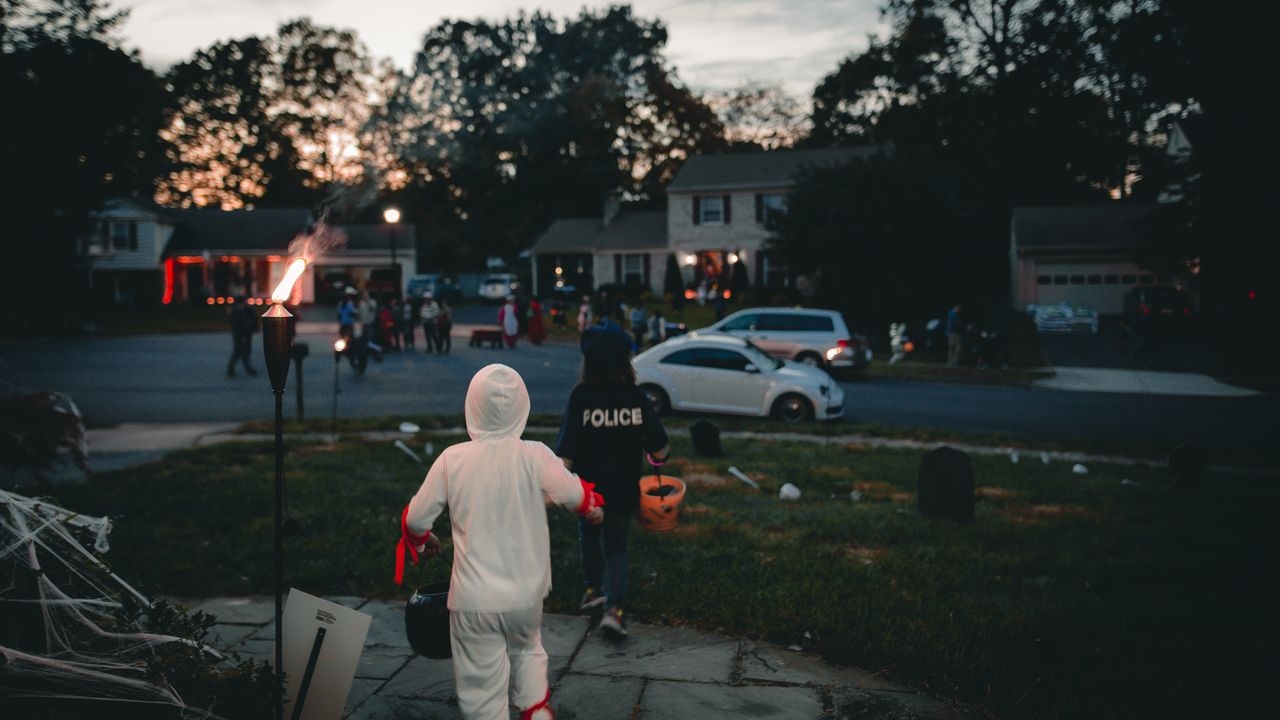
Your child is trick-or-treating or walking to or from a Halloween event when a car turns onto the street. Maybe your child begins crossing between parked vehicles, steps from a driveway toward the other side of the road, or is struck while crossing near an intersection.
Now your child is injured after being hit by a car, and you are trying to understand how the collision happened and whether anything your child did could affect an injury claim.
The driver or insurance company may focus on where your child entered the roadway or whether the driver could see the costume your child was wearing.
But when a child is struck during a Halloween outing, where the child crossed is only one part of the analysis.
Your child's age, where your child entered the road, the driver's speed and attention, lighting, parked vehicles, sight lines, and the other circumstances surrounding the collision can all matter.
Pennsylvania also evaluates a child's conduct differently from an adult's. That distinction can become especially important when an insurance company argues that something your child did contributed to the collision.
Does Pennsylvania Judge a Child's Conduct the Same Way as an Adult's?
No.
Pennsylvania law recognizes that children do not necessarily have the same ability as adults to recognize danger and respond to it.
Rather than automatically judging a child by the standard that would apply to an adult, Pennsylvania considers what could reasonably be expected from a child of similar age, experience, capacity, and development.
Age also affects the legal presumption that applies when determining whether a child can be considered negligent.
Under Pennsylvania case law:
- A child under seven is conclusively presumed incapable of negligence.
- A child between seven and fourteen is presumed incapable of negligence, although that presumption can be overcome depending on the circumstances and grows weaker as the child approaches fourteen.
- A child over fourteen is generally presumed capable of negligence, although evidence may establish otherwise in an individual case.
That does not mean a driver is automatically responsible whenever a child pedestrian is injured. It means your child's actions cannot simply be judged by the same standard that would apply to an adult.
Does It Matter Where Your Child Crossed the Street?
Yes, but where your child crossed does not answer the entire question.
Under Pennsylvania law, a pedestrian crossing outside a marked crosswalk or an unmarked crosswalk at an intersection generally must yield to vehicles on the roadway. Drivers, in turn, generally must yield to pedestrians who are crossing within a marked crosswalk or an unmarked crosswalk at an intersection when traffic-control signals are not in place or operating.
The law also provides that a pedestrian may not suddenly leave a curb or other place of safety and enter the path of a vehicle that is so close as to create a hazard. Those rules are addressed in Pennsylvania's pedestrian traffic laws.
But when a child is struck while trick-or-treating, crossing location is only one part of what happened.
Your child may have been moving between neighboring homes, leaving a driveway, crossing a residential street mid-block, or emerging from between parked vehicles.
Where your child entered the roadway matters, but so does your child's age, what the driver could see, how far away the vehicle was, and how much time the driver had to respond.
Why Can Speed Matter Even If the Driver Was Below the Posted Limit?
The posted speed limit is not the only question after a pedestrian collision.
Under 75 Pa.C.S. § 3361, Pennsylvania drivers must travel at a speed that is reasonable and prudent for the conditions and existing hazards. The law specifically calls for an appropriate speed when special hazards exist involving pedestrians or other traffic, as well as because of weather or roadway conditions.
Those conditions can matter when evaluating whether the driver was traveling at an appropriate speed immediately before the collision.
Was the street crowded with families? Were parked vehicles narrowing the driver's view? Was the road dark? Was the driver approaching an area where children were visible near the roadway?
A driver does not necessarily act negligently simply because an accident occurred under those conditions. But traveling below the posted limit also does not automatically establish that the driver's speed was reasonable.
The question is whether the driver's speed was reasonable for the conditions actually present.
How Do Darkness, Costumes, and Parked Cars Affect the Analysis?
Visibility can become a key issue after a nighttime pedestrian accident.
The driver may say your child was difficult to see because of dark clothing or a costume. You may remember that the street was well lit, that your child was wearing reflective material, that your child had been visible for several seconds, or that other children and families were already nearby.
Parked vehicles can complicate the picture further.
If your child entered the street from between two parked cars, those vehicles may have limited the driver's view. But the same conditions can also raise questions about how fast the driver was traveling and whether the driver was accounting for limited sight lines.
The question is not simply whether visibility was imperfect. It is what the driver could reasonably see under the circumstances immediately before the collision.
What Was the Driver Doing Before Your Child Was Hit?
Attention can be just as important as visibility.
An investigation may look at whether the driver was watching the roadway, using a phone, interacting with passengers, adjusting navigation or other vehicle controls, or otherwise distracted.
It can also matter when the driver first saw, or reasonably should have seen, your child and whether the circumstances gave the driver reason to anticipate that a child might enter the roadway. If the driver had a reasonable opportunity to recognize the danger and respond, questions may include whether the driver slowed down, braked, steered away, sounded the horn, or took other reasonable steps to avoid the collision.
No single detail automatically determines fault. Taken together, however, these circumstances can help show whether the driver was paying attention and responding reasonably to what was happening immediately before the collision.
What Evidence Can Help Show What Happened?
In a residential neighborhood, evidence may come from several nearby sources.
Doorbell cameras can capture part of the street. Home-security systems may show the vehicle approaching or your child entering the roadway. A neighbor may have seen the impact from a porch or window.
Other useful evidence can include:
- Photographs of the roadway and lighting
- The location of parked vehicles
- Damage to the vehicle
- Police observations and witness statements
- Nearby surveillance footage
- Photographs of your child's clothing or costume
- Vehicle data where available
- Measurements or photographs showing sight lines from the driver's direction of travel
When AlpernSchubert, P.C. evaluates a pedestrian crash involving a child, we look at the available evidence together rather than relying on one detail in isolation. That broader picture can help show what the driver could see, how the vehicle and your child were positioned, and whether the surrounding circumstances affected the driver's ability to respond.
Some footage from private cameras may be kept only for a limited time, so identifying nearby cameras early can help preserve information about how the collision occurred.
What If the Insurance Company Says Your Child Caused the Accident?
An insurer may argue that your child ran into the roadway, crossed somewhere other than a crosswalk, or entered from behind a parked vehicle.
Those facts can matter. But they cannot be evaluated without first considering Pennsylvania's rules for determining a child's capacity for negligence and the standard that applies to the child's conduct.
If a child is found capable of negligence and some negligence is attributed to the child, Pennsylvania's comparative negligence law can affect the injury claim.
A finding that your child was partly at fault does not necessarily prevent recovery. Under Pennsylvania law, recovery can still be available when the child's negligence is not greater than the negligence of the defendant or defendants from whom recovery is sought. Any damages awarded are then reduced according to the percentage of negligence attributed to the child.
Before reaching that issue, however, your child's conduct must be evaluated under the rules that apply to minors. Your child's age, experience, capacity, and development can affect whether negligence can properly be attributed to your child and, if so, how that conduct affects the claim.
Was Your Child Hit by a Car in Pittsburgh?
When your child is injured in a pedestrian crash, determining what happened involves more than identifying where your child entered the roadway. Your child's age, the driver's speed and attention, what the driver could see, and the available evidence can all affect how the accident is evaluated under Pennsylvania law.
At AlpernSchubert, P.C., we represent people injured in motor vehicle accidents throughout Pittsburgh and Western Pennsylvania. We help families understand how Pennsylvania law applies to the circumstances of a crash and what issues may affect an injury claim.
If your child was struck by a vehicle while trick-or-treating, walking to or from a Halloween event, or walking through a Pittsburgh or Western Pennsylvania neighborhood, contact AlpernSchubert, P.C. through our online form so we can review what happened and explain how Pennsylvania law may apply to your family's situation.
Disclaimer: The articles on this blog are for informational purposes only and are no substitute for legal advice or an attorney-client relationship. If you are seeking legal advice, please contact the law firm directly.