

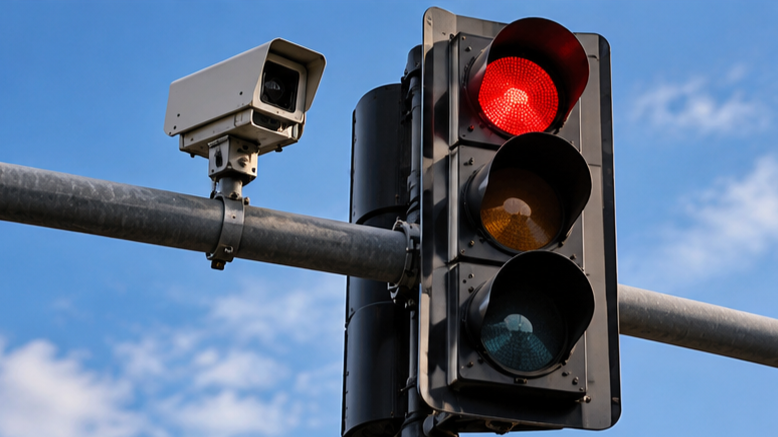
You are driving through a Pittsburgh intersection when another vehicle enters from the side and hits you. You believe the other driver ran the red light, but the other driver tells a different version of what happened.
When the drivers disagree about who had the right of way, it can be difficult to know what evidence will resolve the dispute. If you then notice one of Pittsburgh's new red-light cameras mounted nearby, it may seem as though the answer has already been recorded.
Did the camera capture what happened, and can that footage be used to show that the other driver ran the light?
The answer is more complicated than many drivers may expect.
Pittsburgh launched its automated red-light enforcement camera program in August 2026 at selected intersections with histories of red-light-running crashes. But these cameras have a specific enforcement purpose, and Pennsylvania law places significant restrictions on the records they generate.
If you were injured in a car accident in Pittsburgh, seeing one of these cameras at the intersection does not necessarily mean its recording will be available to prove what happened in your personal injury claim. That can make other evidence surrounding the crash especially important.
What Do Pittsburgh's New Red-Light Cameras Actually Record?
Pittsburgh's Automated Red-Light Enforcement, or ARLE, program uses cameras at selected intersections to identify vehicles that enter after the traffic signal has turned red.
The first two Pittsburgh locations began operating on August 12, 2026, with a 60-day warning period. The city says citations at those initial intersections are scheduled to begin on October 11, 2026.
According to the City of Pittsburgh, the system records images or video beginning two seconds before an infraction is triggered, continuing during it, and ending two seconds afterward.
That does not make an ARLE camera the same as an ordinary surveillance camera.
Pennsylvania law limits recorded images collected through these systems to traffic violations and prohibits using the cameras for other surveillance purposes.
That distinction matters after a crash.
The fact that a camera was present does not necessarily mean it recorded the collision. And even if the system recorded a red-light violation connected with the event, separate rules govern whether that information can be used outside the ARLE proceeding.
Can Red-Light Camera Footage Be Used in Your Injury Claim?
Under 75 Pa.C.S. § 3117, records generated through Pennsylvania's automated red-light enforcement system are subject to significant restrictions.
The statute says information relating to ARLE violations, including recorded images and related records, generally is not discoverable and cannot be offered as evidence in a proceeding that is not directly related to the red-light-camera violation.
A limited exception allows a court to order that the information be provided to law enforcement when it is reasonably described and requested solely in connection with a criminal law-enforcement action.
For someone injured in a collision, the practical point is important:
You should not assume that because an ARLE camera recorded a violation, the footage can simply be obtained and introduced in your personal injury case.
The City's ARLE page also states that recorded images are destroyed within 30 days after final disposition of the recorded event.
That is why it is important to distinguish the city's enforcement cameras from other cameras that may have captured what happened.
Does an ARLE Violation Tell You Who Was Driving?
Not necessarily.
Pennsylvania's ARLE system sends the notice of violation to the registered owner of the vehicle. The law also recognizes defenses, including situations where the person named in the notice was not operating the vehicle at the time of the violation.
That means the ARLE process does not necessarily establish who was behind the wheel.
And separate from the restrictions on using ARLE records in a personal injury case, determining responsibility for a collision requires looking at how the crash actually happened.
Relevant questions can include:
- Which direction was each vehicle traveling?
- When did each vehicle enter the intersection?
- What traffic signal controlled each movement?
- Was either vehicle turning?
- What could each driver see?
- Did either driver have time to react?
- Did another action by either driver contribute to the collision?
Whether a driver entered the intersection against the red light can be important to understanding how the crash happened. However, the injury claim still has to be evaluated in light of the full circumstances and the evidence that is available for the civil claim.
What If Both Drivers Say They Had the Green Light?
This is where an intersection crash can become especially difficult.
One driver says the light was green. The other says the same thing. If the city's ARLE footage cannot be used to resolve what happened, other evidence can become much more important.
A nearby business may have an exterior security camera pointed toward the road. A homeowner's camera may capture part of the intersection. Another vehicle may have dashcam footage. A pedestrian, passenger, or driver waiting nearby may have seen which vehicle entered first or which signal had changed.
Even a recording that does not clearly show the traffic light can sometimes provide useful context. It may show when each vehicle entered the intersection, the direction the vehicles were traveling, how quickly they were moving, or how the impact occurred.
The question becomes what other evidence can help reconstruct the moments leading up to the crash.
What Other Evidence Can Help Explain What Happened?
Video is only one source.
A police report may identify witnesses, record statements from the drivers, describe the traffic controls, or include a diagram of the collision.
Photographs can show vehicle positions, damage, debris, roadway markings, sight lines, and the layout of the intersection. The location and direction of vehicle damage may also help explain how the vehicles came together.
In some cases, information about the signal sequence or traffic controls may provide additional context, particularly when the dispute centers on when a light changed.
At AlpernSchubert, P.C., when our team evaluates an intersection crash, we look at the available evidence together rather than relying on one fact to explain what happened. That broader picture can help clarify what each driver was doing and how the collision occurred.
What If the Insurance Company Says You Were Also at Fault?
An insurance company may argue that even if the other vehicle entered against a red light, something you did also contributed to the crash.
Pennsylvania follows a modified comparative negligence rule. Under 42 Pa.C.S. § 7102, being partly at fault does not automatically prevent an injured person from recovering damages. Recovery can still be possible if the injured person's share of fault is not greater than the fault of the person or people from whom damages are sought. Any damages awarded are reduced according to the injured person's percentage of fault.
In an intersection crash, an insurer might raise questions about speed, distraction, evasive action, or compliance with another traffic rule.
Those arguments still have to be evaluated in light of what the evidence shows. A traffic violation by one driver does not automatically answer every question about how the collision occurred or whether another person's actions also contributed.
Why Is It Important to Identify Other Evidence Early?
Even when ARLE records cannot be used in the civil claim, other evidence may not remain available indefinitely.
A nearby business or homeowner may keep surveillance footage only for a limited time. Witnesses can become harder to locate, vehicles may be repaired, and conditions at the intersection can change.
Identifying potential evidence early can help preserve a clearer picture of what happened before footage is deleted, vehicles are repaired, or other information becomes more difficult to obtain.
Injured in a Pittsburgh Intersection Crash?
Pittsburgh's new red-light cameras may document certain traffic violations, but their presence at an intersection does not necessarily mean their footage can be used to prove a personal injury claim.
When drivers disagree about who had the green light, other evidence such as surveillance footage, witness accounts, photographs, vehicle damage, and information about the intersection can become important in determining how the collision happened.
At AlpernSchubert, P.C., our Pittsburgh motor vehicle accident lawyers represent people injured in crashes throughout Western Pennsylvania. We evaluate the circumstances surrounding the collision, the Pennsylvania traffic laws that apply, and the available evidence to understand how the crash occurred and how those facts may affect an injury claim.
If you were injured in a Pittsburgh intersection crash and believe another driver entered against the light, contact AlpernSchubert, P.C. through our online form so we can review what happened and explain how Pennsylvania law may apply to your situation.
Disclaimer: The articles on this blog are for informational purposes only and are no substitute for legal advice or an attorney-client relationship. If you are seeking legal advice, please contact the law firm directly.